

The investment philosophy of Peter Lynch, the legendary manager of Fidelity's Magellan Fund, focuses on finding well-run companies with strong growth prospects that are trading at reasonable prices, a strategy often termed Growth at a Reasonable Price (GARP). Lynch supported a long-term, buy-and-hold method, concentrating on fundamental health and sustainable growth instead of market timing. A key part is the PEG ratio, which compares a stock's price-to-earnings (P/E) ratio to its earnings growth rate, with a value of 1 or less pointing to a possibly attractive valuation. He also highlighted strong profitability, manageable debt, and solid financial health as foundations for lasting success.
One company that recently appeared from a screen using Lynch's main criteria is Black Stone Minerals LP (NYSE:BSM), a Houston-based owner of oil and gas mineral and royalty interests. For investors looking for long-term growth at a reasonable price, BSM offers a case that fits closely with several Lynch ideas.
Fit with Lynch's Growth and Valuation Filters
The screen uses specific quantitative filters taken from Lynch's strategy. Black Stone Minerals passes these key tests, which are made to find companies with sustainable growth and sensible valuations.
- Sustainable Earnings Growth: Lynch preferred companies increasing earnings per share (EPS) between 15% and 30% each year over a five-year span, seeing this pace as sustainable. BSM's five-year EPS growth rate of 28.47% fits within this target range, showing a good and steady history of profit growth.
- Attractive Valuation via PEG: The central part of Lynch's valuation method is the PEG ratio. A PEG of 1 means the stock's price matches its growth rate, while a number below 1 may show it is priced low compared to that growth. BSM's PEG ratio, using its past five-year growth, is 0.43. This very low ratio suggests the market may be valuing the company's shares without completely reflecting its historical earnings growth path.
- Strong Profitability (ROE): Lynch searched for companies that efficiently create profits from shareholder equity. A Return on Equity (ROE) above 15% was a sign of a well-run business. BSM's ROE of 23.97% is much higher than this level, showing a high degree of profitability and effective use of capital.
- Conservative Financial Structure: To ensure strength, Lynch liked companies with low debt. The screen asks for a Debt-to-Equity ratio below 0.6, with Lynch himself favoring an even stricter below 0.25 level. BSM's ratio of 0.14 shows an extremely conservative balance sheet, funded mainly by equity instead of debt, which lowers financial risk in economic declines.
- Solid Short-Term Health: The Current Ratio checks a company's ability to pay its short-term bills. A ratio of 1 or more is seen as healthy. BSM's Current Ratio of 3.88 points to strong liquidity and a good financial standing to handle near-term demands.
Fundamental Health and Quality Summary
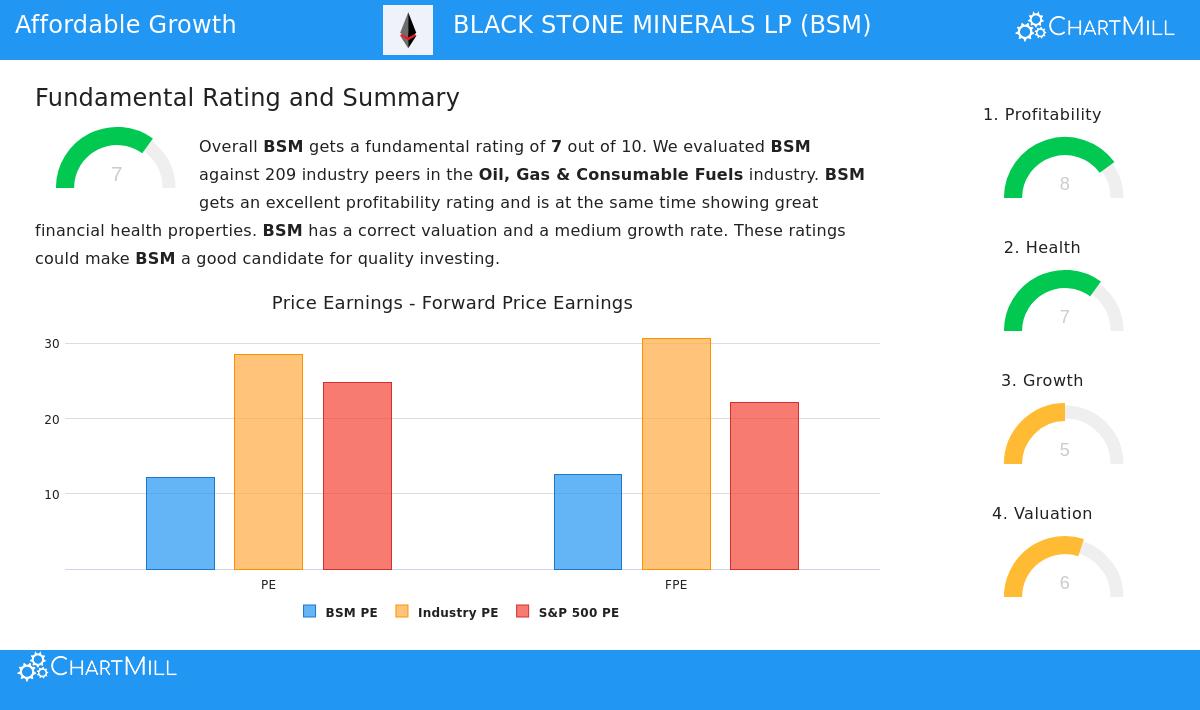
A wider view of Black Stone Minerals' fundamental profile, as shown in its detailed analysis report, supports the image from the Lynch screen. The company gets a good overall fundamental rating, with specific high points in profitability and financial health.
Its profit margins are very good within the Oil, Gas & Consumable Fuels industry, and it rates well on return measures like Return on Invested Capital (ROIC). The health score is supported by its very low debt and high liquidity, as seen in the ratios above. On valuation, the report states that BSM trades at a P/E ratio that is lower than most of its industry peers and the wider S&P 500, which matches the low-priced signal from the PEG ratio.
A point for investors to note, which Lynch would probably examine, is the dividend. While BSM provides a high yield, the fundamental report notes that its payout ratio is currently not maintainable if earnings growth decreases, marking an area for more study.
A Candidate for More Study
For the GARP investor, Black Stone Minerals LP stands as a classic "Peter Lynch-style" discovery: a company with a shown history of strong earnings growth, high-level profitability, and a very strong balance sheet, all available at a valuation that seems reasonable, if not low, when growth is considered. It works in the essential, if sometimes changing, energy sector, owning royalty interests that provide a steady revenue stream without the high operational costs of exploration and production.
This analysis started with a stock screen made to filter for Lynch's ideas. Black Stone Minerals (BSM) is one of the current results of that process. Investors curious about finding other companies that currently pass these tests for sustainable growth at a reasonable price can see the full screen results here.
As always, a screen is a beginning for research, not a buy suggestion. Lynch's most important advice was to "invest in what you understand." Any potential investor should completely research Black Stone Minerals' business model, its link to commodity price cycles, and its dividend policy before making an investment choice.
Disclaimer: This article is for informational purposes only and does not constitute financial advice, an endorsement, or a recommendation to buy, sell, or hold any security. Investing involves risk, including the potential loss of principal. You should conduct your own research and consult with a qualified financial advisor before making any investment decisions.