

For investors looking for a dependable source of passive income, a methodical screening strategy is necessary. One useful technique focuses on companies that provide an appealing dividend and also have the fundamental financial soundness to maintain and possibly increase those payments. This method looks past targeting only the highest yield, which can sometimes indicate a company in trouble. It emphasizes quality by selecting stocks with a high ChartMill Dividend Rating, which assesses yield, growth, history, and sustainability, while also demanding acceptable scores in Profitability and Financial Health. This pairing finds companies that are sufficiently profitable to support their dividends and financially secure enough to endure economic shifts.
Baker Hughes Co (NASDAQ:BKR) appears from such a screen as a name for further review by dividend-oriented investors. As a significant company in the energy technology field, supplying equipment and services for the oilfield and industrial energy markets, its operations produce the steady cash flows that support a lasting dividend program.
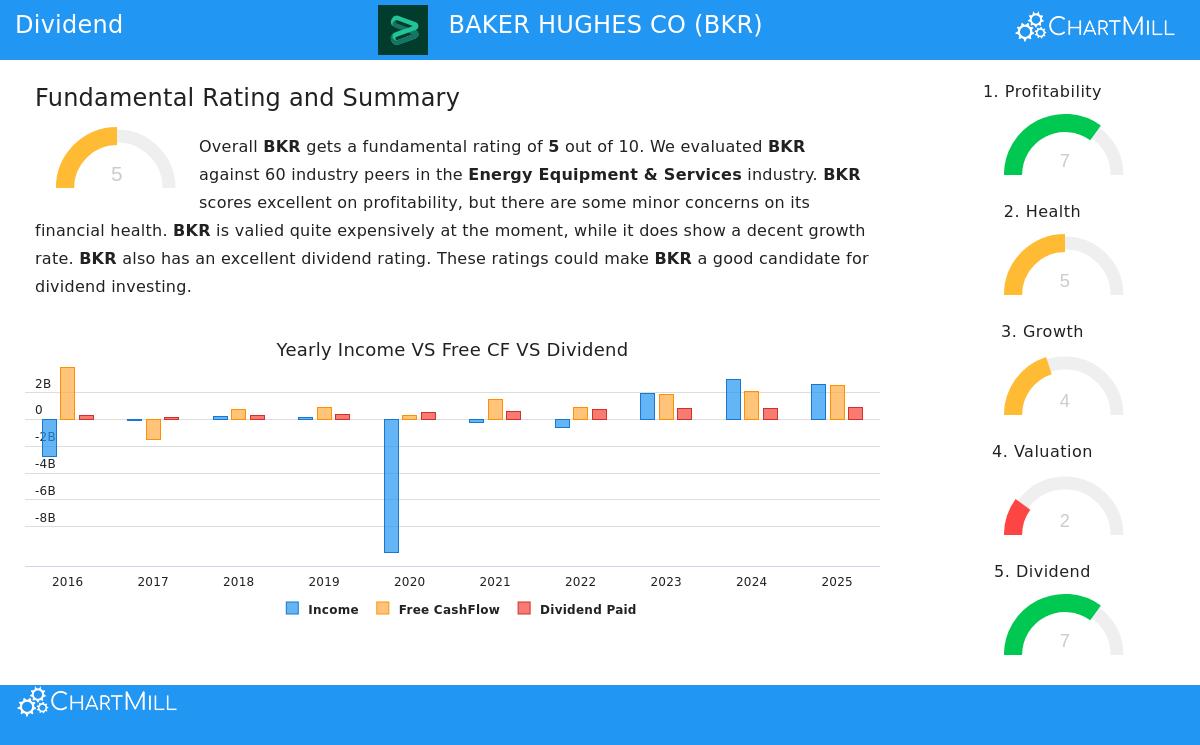
Dividend Profile: Dependability Over Flash
The central attraction for dividend investors is BKR's steady and dependable distribution policy. The company's dividend traits show a priority on longevity rather than attention-grabbing, but possibly unstable, high yields.
- Yield and Growth: BKR provides a dividend yield of 1.53%, which is higher than the average for similar companies in its field. Although not extremely high, this yield is paired with a history of stable, gradual growth. The dividend has increased at a yearly rate of about 5.32% over the last five years, showing a policy of returning more capital to shareholders.
- Proven Track Record: Possibly most critical for income investors, BKR has a dependable history. The company has paid a dividend for at least ten straight years and has not cut its payment in that time. This long-term consistency is a vital sign of management's commitment to shareholders and offers a level of predictability for income portfolios.
- Sustainable Payout: The longevity of the dividend is supported by a cautious payout ratio. BKR distributes about 35% of its net income as dividends. This keeps a large part of earnings to be put back into the business for expansion, debt payment, or other uses, building an important cushion to keep the dividend during times of reduced earnings.
Supporting Fundamentals: Profitability and Financial Health
A good dividend depends on the company behind it. BKR's scores in Profitability and Financial Health give the necessary foundation that makes its dividend policy believable. This is exactly why filtering for these measures is important, they show the company's ability to produce the earnings and cash flow required to support shareholder returns.
- Profitability Strength: BKR receives a good ChartMill Profitability Rating of 7. Important measures like Return on Equity (13.74%) and Return on Invested Capital (10.47%) place it above many in its industry. Also, its operating margin has gotten better in recent years. This fundamental profitability creates the funds for the dividend; without it, any payment is fundamentally unstable.
- Adequate Financial Health: With a ChartMill Health Rating of 5, the company's financial condition is viewed as acceptable. Its solvency measures are mostly positive, with an acceptable debt-to-equity ratio of 0.29, showing it does not depend too much on debt. The report mentions some small points about liquidity ratios (Current and Quick Ratio), which investors should note. Still, the overall financial view indicates the company is not in immediate financial trouble that would endanger its dividend, matching the screening aim of steering clear of financially weak firms.
Valuation and Growth Context
It is necessary to consider the dividend offering alongside the company's complete valuation and growth prospects. BKR is now trading at a Price-to-Earnings ratio that seems high compared to its own past but is more in line with the wider S&P 500. Analysts project slight growth in both earnings and revenue in the near future. For a dividend investor, the main attention stays on the longevity of the payment. The company's sound profitability and cautious payout ratio help address worries that a higher valuation might create for growth-focused investors.
A Detailed Fundamental Analysis of BKR is available here.
Conclusion
For investors using a quality-centered dividend strategy, Baker Hughes Co offers a strong example. It represents the kind of company a disciplined screen intends to identify: one with a steady, increasing dividend supported by good profitability and acceptable financial health. The yield is solid, the history is stable, and the payment is well-supported by earnings. While having some points to observe, like liquidity and valuation, BKR’s fundamental picture indicates it has the ability to keep acting as a provider of passive income for shareholders.
Interested in examining other companies that fit similar standards for dividend dependability, profitability, and financial health? You can run the "Best Dividend Stocks" screen yourself to see the full list of current candidates here.
Disclaimer: This article is for informational purposes only and does not constitute financial advice, a recommendation, or an offer or solicitation to buy or sell any securities. The information presented is based on data provided and should not be the sole basis for any investment decision. Investors should conduct their own due diligence and consult with a qualified financial advisor before making any investment. Past performance is not indicative of future results.