
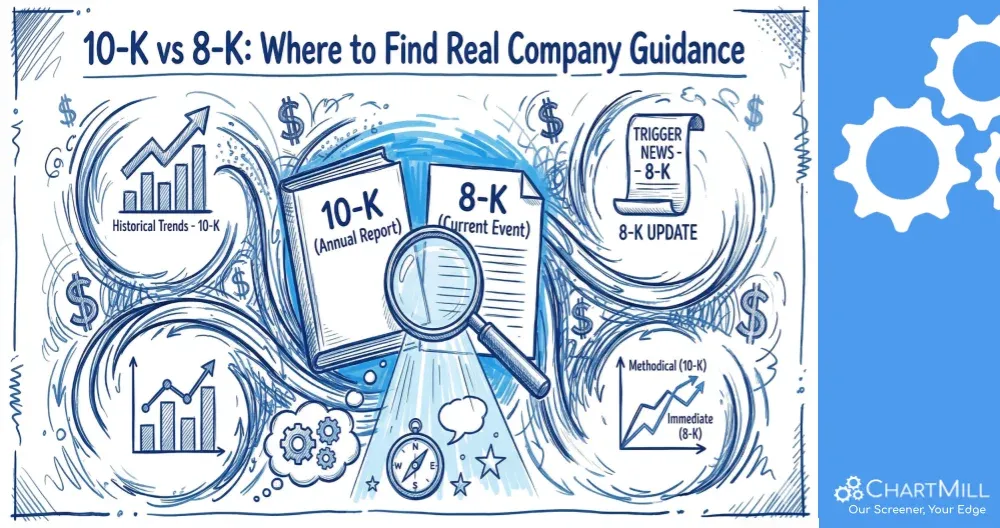
10-K vs 8-K: Where to Find Real Company Guidance
Stop relying on the 10-K for future predictions. Discover how to use 8-Ks and transcripts to find management guidance and track company reliability.
10-Ks are for Accountants. 8-Ks and Transcripts are for Investors.
Every new investor is given the same advice: "Read the Annual Report (10-K)." So, you grab a coffee, suffer through 150 pages of legal jargon, and by the time you’re done, you know everything about last year's accounting.
But do you have any idea what the stock is going to do next week? Probably not.
The problem is simple: a 10-K is an autopsy. It tells you exactly what the patient almost died of last year, but it says very little about tomorrow's fitness. If you want a real "outlook," you need to stop digging in the past and start looking at the live signals.
1. The 8-K: The News That Actually Moves the Needle
Forget the massive yearbooks for a moment. The 8-K is where the action is. This is the document a company must file when something happens now.
The Q4 Release: This is the most important 8-K of the year. It contains the numbers from the final quarter, but more importantly, it contains the Guidance.
While the 10-K takes weeks to be finalized and audited, the 8-K gives you the raw numbers that analysts use to set their price targets. If you want the 2026 outlook, find the 8-K filed in February 2026.
2. Transcripts: Listen to What They Don't Say
A press release is scrubbed by ten different lawyers. But in an Earnings Call (the transcript), the CEO has to answer questions from analysts live.
The Q&A is Gold: When an analyst asks why margins are shrinking and the CFO starts dodging or muttering about "macroeconomic headwinds" without getting specific, you have your answer.
The tone and the fine details in these conversations provide context that you will never find in a spreadsheet inside a 10-K. It’s the difference between reading a weather report and standing outside in the rain.
3. The Proxy Statement: Follow the Money
This is the favorite of the "lazy but smart" investor. The Proxy Statement (DEF 14A) shows you exactly how the executives get paid.
Does the CEO get a bonus if revenue grows? They’ll likely make reckless acquisitions just to look bigger.
Is the bonus tied to Free Cash Flow? They’ll be watching every penny.
The Lesson: Follow the boss’s paycheck, and you’ll know exactly where the company is headed.
The "Reality Check" Strategy
If you want to know if a company actually keeps its promises over a five-year period, do this:
-
The Promise: Grab the 8-K from the beginning of each year. What did they say they were going to do?
-
The Result: Grab the 10-K at the end of that year. Did they actually do it?
-
The "Spin" Factor: If they missed, read the transcript for that quarter. Did they blame the market, or did they take responsibility? This tells you everything you need to know about management’s integrity.
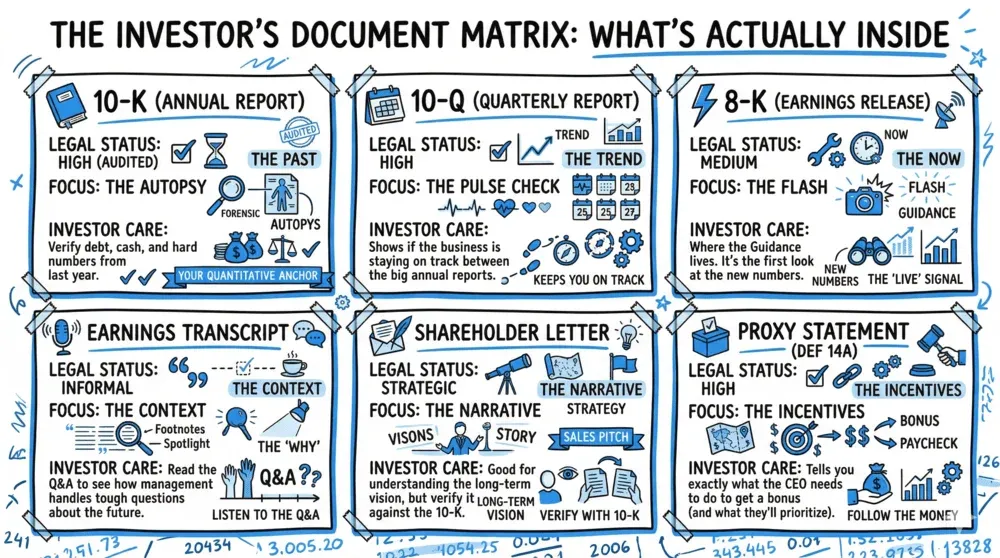
The Investor’s Document Matrix
Frequently Asked Questions (FAQ)
Q: Why are there only three 10-Q reports per year?
A: This trips up a lot of people. A fiscal year has four quarters. For the first three (Q1, Q2, Q3), the company files a 10-Q. For the fourth quarter (Q4), they don't—those results go straight into the big annual 10-K.
Q: Is the "Shareholder Letter" a legal filing?
A: No. Think of it as the "PR version" of the vision. It’s useful for understanding the long-term strategy, but always verify it against the hard numbers in the 8-K.
Q: Why doesn't the 10-K just include clear guidance?
A: Liability. Companies are terrified of putting hard promises in an audited legal filing. They prefer the 8-K and Earnings Calls because they can include "Forward-Looking Statement" disclaimers that protect them if things go south.
Q: What is the most important part of an Earnings Transcript?
A: The Q&A. Skip the "prepared remarks"—that’s just a script. Go straight to the part where the analysts start pushing back.