

Yesterday, Microsoft released its latest quarterly results.
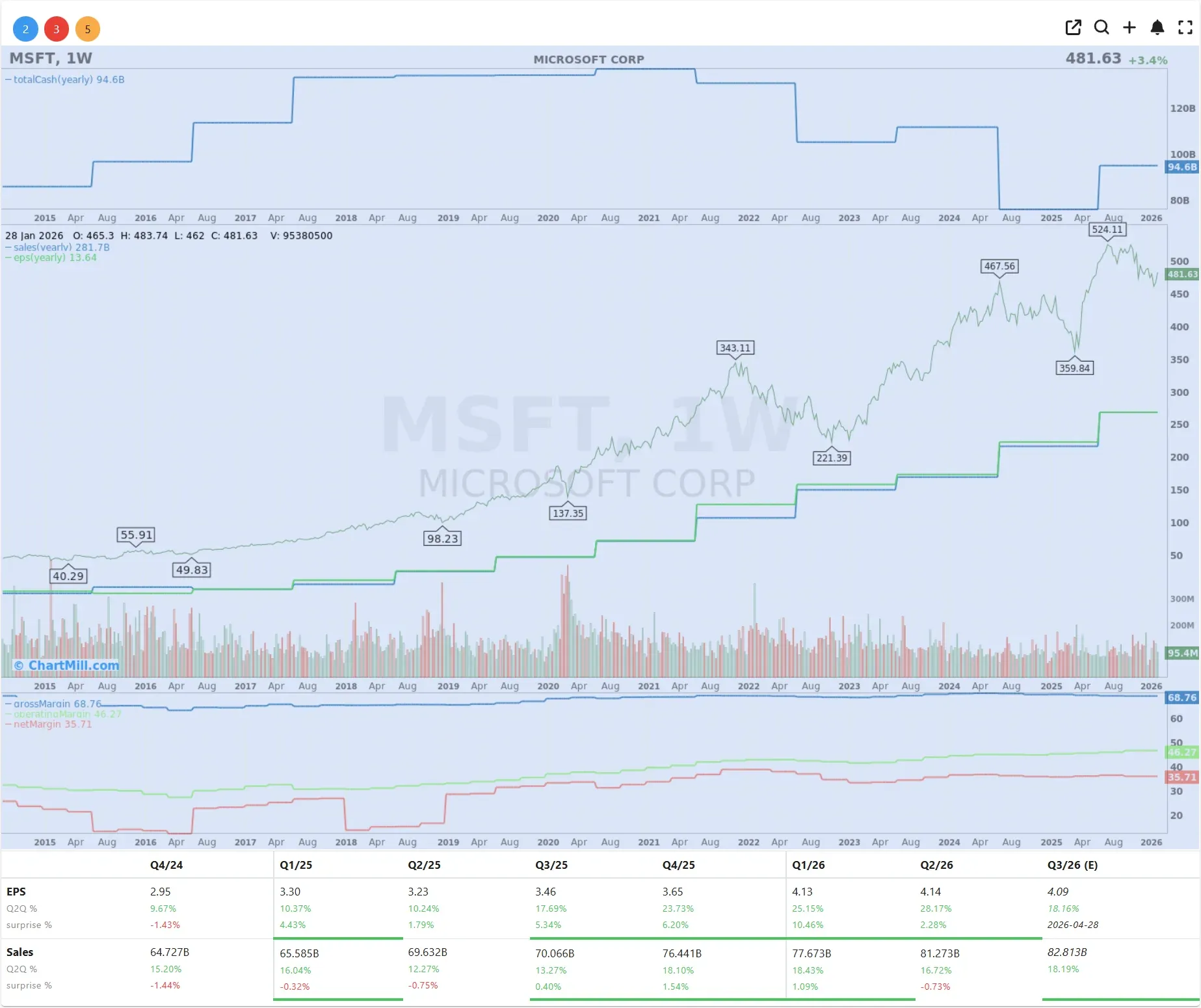
The paradox couldn’t be more striking: the company reported a record revenue of $81.3 billion, a 17% increase. Earnings per share also climbed faster than anticipated, rising 24% to $4.14. Yet, despite these strong numbers, the stock dropped by 7% during the after-hours analyst call.
The reason? The market seems spooked by the "bill" for the future.
Quality Over Quantity
There is currently a lot of noise regarding the $37.5 billion in capital investments, a 66% increase that exceeded analyst expectations. While Azure grew 38% , critics are pointing to capacity constraints that might be slowing down the conversion of bookings into sales.
Personally, I find Microsoft’s deliberate choice to allocate a portion of that scarce computing power to internal teams to improve products like Copilot to be a fascinating strategic move. Management even noted that if all that capacity had been funneled into Azure, growth there would have been significantly higher.
In my view, this is the only correct path forward:
-
Long-term Vision: Sacrificing quality for quantity is never a sustainable structure for long-term success.
-
Strategic Positioning: In a breakneck market environment, you must choose a direction and stick to it; prioritizing the best product experience is vital, even if it temporarily tempers direct cloud growth.
-
Essential Infrastructure: You simply cannot lead an AI revolution without investing in the foundation - the data centers and the R&D - required to power it.
The Demanding Investor
This seems to be a widespread phenomenon in the market today, and it isn't unique to Microsoft. It appears that many investors are eager to reap the rewards, but they often forget that for a bush to bear fruit, it must first be fertilized.
As CEO Satya Nadella pointed out, we are still in the early stages of the AI era. This is an incredibly complex exercise where every major player is still figuring out how to position themselves in a rapidly changing landscape. In this phase, investing in infrastructure isn't just a "cost", it’s a prerequisite for existence.
May I make a bold statement?
If you aren't willing to accept the investments of today, you don’t deserve the profits of tomorrow.
What do you think? Is the market’s reaction a sign of healthy realism regarding costs, or a concerning lack of patience for fundamental innovation?
Kristoff - ChartMill