

For investors aiming to build a portfolio focused on creating reliable passive income, a disciplined screening process is necessary. One useful method involves filtering for companies that not only provide an appealing dividend today but also have the fundamental financial strength to maintain and possibly increase those payments over time. This approach often looks for stocks with high dividend ratings, which assess yield, growth, and sustainability, while also demanding a baseline of good profitability and financial condition. This mix seeks to find businesses that can dependably return cash to shareholders without risking their operational stability.
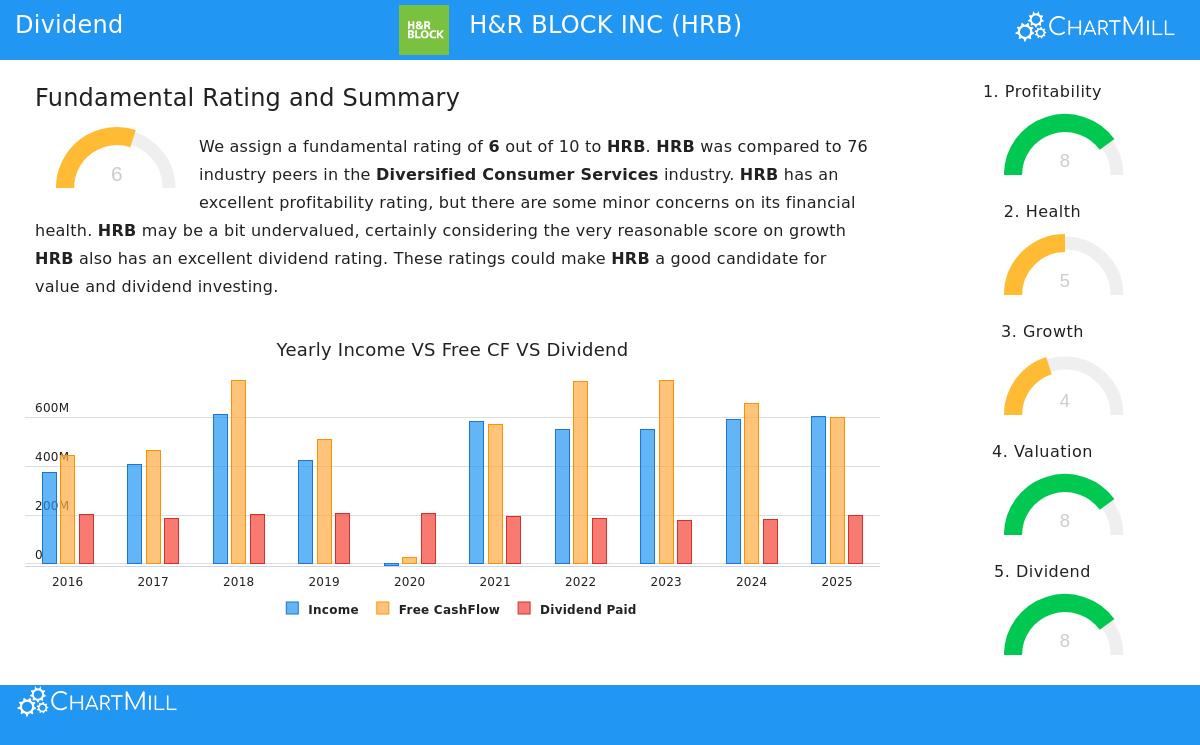
H&R BLOCK INC (NYSE:HRB) appears as a candidate worth further review through this view. The tax preparation company's fundamental profile makes a strong case for dividend-focused investors, balancing a solid return of capital with a firm operational base.
Dividend Strength: A Main Attraction
The main attraction for income investors is HRB's well-supported dividend. The company's ChartMill Dividend Rating of 8 out of 10 shows good scores across important measures that count for long-term income creation.
- Appealing and Increasing Yield: HRB currently provides a yearly dividend yield of 3.94%, which is more than double the current S&P 500 average. More significantly, this is not a fixed payment. The company has increased its dividend at a yearly rate of 6.79% over the past five years, showing a dedication to raising shareholder returns.
- Established History: Dependability is critical in dividend investing. HRB has built a reliable record, having paid a dividend for at least ten straight years without a cut. This steadiness gives a degree of assurance for investors relying on consistent income.
- Maintainable Payout: A high yield is only useful if it is maintainable. HRB's payout ratio—the percentage of earnings paid as dividends—is at a very workable 33.41%. This shows the company keeps a large part of its profits to put back into the business, manage debt, and handle economic slowdowns, all while funding the dividend without strain. The report also states that earnings are increasing faster than the dividend, supporting the payout's maintainability.
Supporting Fundamentals: Profitability and Valuation
A good dividend cannot stand alone; it must be backed by a profitable company. This is where the screening rule for "good profitability" shows its value. HRB's ChartMill Profitability Rating of 8 points to an efficient operation.
The company performs well in capital use, with a Return on Invested Capital (ROIC) of 35.30%, doing much better than most of its industry competitors. Its profit margin of 16.10% is also high relative to the sector. These numbers indicate HRB is not only creating earnings, but doing so effectively, which is the final source of dependable dividend payments. Also, this operational strength results in a good valuation. With a Price-to-Earnings (P/E) ratio of 8.61 and a forward P/E of 7.30, HRB is priced lower than most of its industry and the wider market, possibly providing a margin of safety for value-aware dividend investors.
A Note on Financial Condition
The screening process also required a minimum level of financial condition, an important filter to avoid companies that might be paying dividends from borrowed time or money. HRB's ChartMill Health Rating of 5 shows a mixed but workable situation. On the good side, the company has a sound Altman-Z score showing no near-term bankruptcy risk, a fair debt-to-free-cash-flow ratio, and has been lowering its share count. However, investors should note a point of watchfulness: liquidity ratios (Current and Quick Ratio) are below 1.0, which is low for the industry. This indicates the company could have difficulties if it needed to meet all short-term obligations at once. For a seasonal business like tax preparation, this needs context and knowledge of its yearly cash flow cycle, but it stays an area for observation.
Conclusion
For investors using a strategy that emphasizes maintainable income, H&R Block offers an interesting example. It successfully meets a filter looking for high dividend quality, supported by strong profitability and a fair valuation. The company's appealing yield, history of increase, and low payout ratio form the basis of its attraction. While the lower liquidity numbers deserve notice, the overall fundamental view—especially the high returns on capital and earnings ability—suggests the dividend is built on a stable base. As with any investment, this review is a beginning step, highlighting the need to understand the business model and its cyclical character.
Interested in reviewing other stocks that meet similar dividend, profitability, and condition filters? You can see the full screen and its results here.
Disclaimer: This article is for informational purposes only and does not constitute financial advice, a recommendation, or an offer or solicitation to buy or sell any securities. The analysis is based on historical data and current metrics, which are not guarantees of future performance. Investors should conduct their own research and consider their individual financial circumstances before making any investment decisions.